The Yonderist

All those who wander are not lost.

Drawing a Duck at 2

Lily recently got out a dry-erase workbook, wanting to work on her drawing abilities — which have exploded of late. When we went through it to clean out older markings. from when she was two, we came across this rendering of a duck that we thought was worth capturing.

Drawing a Duck at 2

Process Diagramming at Its Best

From Linda at OmniGroup:

Infant Process

Something to Think About

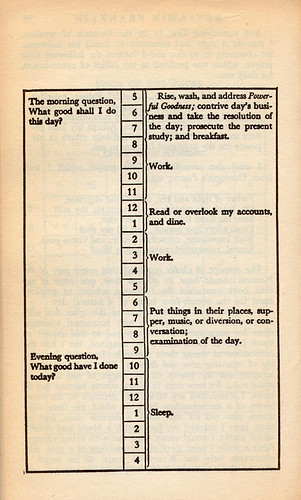
Perhaps the internet really is wise through sheer volume of activity. I loved coming across this scan:

That’s quite a schedule old Ben kept. My first thought was “yeah, that’s a bachelor.”

The Road to Digital Considered

A recent posting on Ars Technica about the American Chemical Society’s “road to digital” publishing spurred an interesting discussion, but a surprising number of posters fumed about the loss of print. I took a moment to write about the issue, using what little I know about how things work for my own society, the American Folklore Society:

I, too, enjoy serendipity and have profited immensely in my intellectual and professional development from reading the card behind the one for which I was searching while in the card catalog or from seeing the title of a book on the shelf above the one for which I was looking. That said, that notion of browsing is not really lost in the digital realm. These things are called “browsers” after all and the rise of the multi-tab interface that allows one to open multiple other texts while one stays focused on another speaks directly to the ability to browse easily in the digital realm.

I am the editor of a website for a small scholarly society in the humanities, the American Folklore Society, that is about to make its premiere on October 1. We are deploying this new/additional communication platform in addition to our journal of record, the Journal of American Folklore. JAF already exists in print and digital form: as a paper product produced and shipped by the University of Illinois Press and as an electronic product available through Project Muse (5 most recent years) and through JSTOR. Having had a chance to talk some with the CIO for JSTOR through the Project Bamboo workshops, I have to say that JSTOR is really trying to do this right. And I would bet that they, too, are looking for some better format than PDF that is, in some ways, too heavily focused on print as an eventual outcome. (You would think in this era of XML and XSLT we would be there already, but, alas, we are not.)

Our society is not alone in being somewhat dependent on the revenue generated by subscriptions to the journal. Like any number of scholarly societies, subscriptions are considerably larger than the active members in the field and are largely dependent upon libraries around the world. In some way, libraries subsidize small scholarly societies as well as, perhaps, large ones. Perhaps that is as it should be. The true cost of running a scholarly society, as opposed to a professional society which can probably charge more for membership, can probably never be born by its members — unless, perhaps, they agglomerate into larger and larger groups for economies of scale. E.g., the American Anthropological Association. (Which now has a number of breakaway groups and journals because the views of the center cannot encompass the many views of its many edges.)

At the same time as all this is happening, libraries have been bearing the costs of both print and digital editions of scholarly products like journals. That kind of expansion of costs for, ostensibly, the same product was bearable when money was less of a concern. But it’s a concern now and likely to remain one for a while. And so, libraries now have to begin making choices that perhaps should have been made a long time ago. Not surprisingly, they find digital more cost effective across a number of fronts.

The obvious needs to be said here: digital production in no way inhibits users from printing out materials and reading them the old-fashioned way. It’s just that the cost of doing so, and the hassle of it to some degree, is now directly born by the print user and not by the larger economy. Pay as you go, as it were. With any luck, some of the hassle will get removed as print-on-demand devices become more common and more available so one could download an entire copy of a journal and have it printed and bound — that’s one of the satisfactions of hoisting a book that I don’t know the digital realm will ever replace.

I should be clear: I love books. I love the way they feel, smell, look. I paid my way through undergrad and parts of grad doing graphic design work. I love the printed page. But I’m also a realist, and we’re in serious need of a re-think about how all this goes. I know some will lament the loss of page numbers for citations, but what need the page number when you can search the text for the quotation yourself and get to it faster than flipping through pages and scanning paragraphs?

DIY Short URLs

With the demise, and later reprise, of tr.im, the Twitterati were momentarily consumed with the status of all the stuff to which they have linked in their posts. I was a little surprised that the concept of “link rot” had not already saturated into the Twitter echo chamber. I figure if I have heard about it, and even thought about it, then surely others, especially those as well, and oft, connected as the Twitter set.

For those who missed it, the saga in short form goes something like this: Twitter posts are restricted to the 140 characters of SMS messages, which means lengthy URLs can consume a disproportionate amount of space with a message. Take, for example, the URL for this post:

http://johnlaudun.org/20090812-diy-short-urls/

It’s 46 characters long, or roughly one-third of any message one posted. A number of URL shortening services have arisen to solve this problem: tinyurl, bitly, tr.im among them.

What happens when these services go away? For many, so will their links, and since much of the web’s meaning is written in links, a chunk of what the web is about will disappear as well. In the face of this problem — and also because who really wants to hand over their own mean-making to a third party who could later subvert the link? — a number of bloggers and developers of blogging apps have come up with their own URL shortening tools. WordPress is no exception. I have added le petite url plug-in to my own site’s infrastructure, which creates a unique, permanent, and self-hosted shortened URL for each post. If you are curious, the shortened URL for this post is:

http://johnlaudun.org/nhqbd

My Apple Galette

As I noted on the Flickr description, the genius of this recipe from Cook’s Illustrated is that I learned that adding one tablespoon corn starch to each cup of all-purpose of flour really delivers a great crust. I was, at first, surprised at how little sugar there was on the apple slices, only one-quarter of a cup for the whole dish, and no spices, but once I tasted the complete dish, it made sense. The apple-cinnamon-sugar combo is very American. This tastes like desserts I have had in Europe: much more apple flavor. (This is not a put-down of American cuisine, only an observation about how baked apple desserts have come to be cooked predominantly in the mainstream American tradition.)

Apple Galette

How I Made My Wife Laugh (Somewhat Hysterically)

There comes a time in every man’s life … oh, let’s cut to the chase:

I was trying to repair our lawn mower when I realized that I was faced with the conundrum of aging: if I got close enough to examine a bolt hole for stripped threads, I couldn’t see the threads clearly; if I got far enough away to see the threads clearly, I was no longer close enough to see the threads clearly.

Alas, my eyes are older and in need of augmentation. AKA “cheaters.”

So off we went to Albertson’s for a grocery run and to stop by the pharmacy section for me to pick up a pair of reading glasses. There wasn’t a wide selection of styles, but what there was came in various prescriptions, and I wasn’t quite sure what would work. I decided to work from the lowest to the highest and see what worked.

As I tried on the first pair of glasses, I realized I needed something to look at or to read that would give me a reasonable real-life test. The little side-of-the-end-cap display for the glasses had nothing there, so I reached to pick up a box on the shelf nearby. (Remember, this is the pharmacy section of the store.) What I grabbed was a box of K-Y Jelly.

So, there I stood in the middle of Albertson’s alternately putting on a different pair of reading glasses and then peering at a box of K-Y Jelly.

Yung could not stop laughing.

Some Things You Can’t Make Up

See Item 3 in the course requirements below:

Spring 2009

Intelligent Design (SOUTHERN EVANGELICAL SEMINARY AP 410, 510, and 810; May 11 – 16, 2009)

THE DUE DATE FOR ALL WORK IN THIS COURSE IS AUGUST 14, 2009. Here’s what you will need to do to wrap things up:

AP410. This is the undegrad course. You have three things to do: (1) take the final exam (worth 40% of your grade); (2) write a 3,000- word essay on the theological significance of intelligent design (worth 40% of your grade); (3) provide at least 10 posts defending ID that you’ve made on “hostile” websites, the posts totalling 2,000 words, along with the URLs (i.e., web links) to each post (worth 20% of your grade).

The Cult of the Author in the New Economy

The writers at Wired are regularly wrong — the “long boom” anyone? — but they are usually thought-provoking in the process. At the very least, folks like Kevin Kelly and Chris Anderson are prolific, practically living embodiments of what is sometimes called Google’s approach to doing business: “Have a lot of ideas; fail often.”

Chris Anderson is, of course, most famous — if one ignores his current infamy for suggesting that everything should be free — for describing the long tail, which suggests, as per the diagram below, that there is a reasonable income to be made in the “long tail” of sales that occurs over time. The high “head” on the left of the graph is where hits live. Anderson’s argument is that there is more money in the long tail and that retailers like Amazon.com, Netflix, and iTunes have already discovered this and can, thanks to lowering costs by having an internet storefront and centralized, and efficient, inventory systems (or digital inventory in the case of iTunes) take advantage of the overall scene.

The Long Tail

Chris Anderson’s “Long Tail”

This is, as Kevin Kelly points out, extremely good news for two groups: the retailers who occupy these markets and the consumers who shop in them who now have access to considerably more, and considerably more varied, commodities.

Everyone wins, right?

Well, certainly the mainstream media/content producers continue to win as they stay focused on producing the hits that occupy the head. They spend a lot in order to make a lot. They have an infrastructure for doing so. There may be some settling, and some shrinkage Anderson seems to suggest at times in his argument, but at least in this moment in time there seems little reason to believe that such industries won’t continue to play significant roles in the market place.

But what about individual/independent producers? Do they get to win, too?

While the public may be interested in, and be profiting from, the greater variety of materials available to them, it would seem that the advantage lies with the content aggregators like Amazon and Netflix and iTunes who can successfully ride the long tail, as it were, by selling an obscure novel here, renting an odd film there, or making available a one-hit wonder from two decades ago. That kind of aggregation might make economic sense for the aggregator, but does it work for the aggregated?

Kelly thinks there is a way to make a living in the long tail, and it consists in cultivating and maintain 1000 true fans. Kelly’s description of a true fan is:

someone who will purchase anything and everything you produce. They will drive 200 miles to see you sing. They will buy the super deluxe re-issued hi-res box set of your stuff even though they have the low-res version. They have a Google Alert set for your name. They bookmark the eBay page where your out-of-print editions show up. They come to your openings. They have you sign their copies. They buy the t-shirt, and the mug, and the hat. They can’t wait till you issue your next work. They are true fans.

His economic argument for 1000 true fans runs like this:

Assume conservatively that your True Fans will each spend one day’s wages per year in support of what you do. That “one-day-wage” is an average, because of course your truest fans will spend a lot more than that. Let’s peg that per diem each True Fan spends at $100 per year. If you have 1,000 fans that sums up to $100,000 per year, which minus some modest expenses, is a living for most folks.

It’s an interesting idea. Kelly suggests that some things a content creator is going to have to learn to give away — in the case of musicians it may very well be the music itself — in order to establish a relationship with an audience and sell them other things, e.g., concert tickets, tee shirts, autographed copies of special collections and/or collectibles. The goal is to cultivate within any given audience the true fans who will reside at the center of concentric rings:

True Fans

.

Kelly admits that there will be movement into and out of the circles: creators will “connect” with audience members differentially — with different individuals for different reasons at different moments within their lives. But, he argues, the only way to make that connection, to establish the relationship that will become your economic lifeline that will enable you to continue creating content, is to be open to the relationship, and to recognize its importance, in the first place. Kelly’s argument is quite clear:

The key challenge is that you have to maintain direct contact with your 1,000 True Fans. They are giving you their support directly. Maybe they come to your house concerts, or they are buying your DVDs from your website, or they order your prints from Pictopia. As much as possible you retain the full amount of their support. You also benefit from the direct feedback and love.

The Cult of the Author

Stay tuned for an update in the next few days…

More on RAW and JPEG

This past spring Pravina Shukla asked me what a JPEG file was and what was the best way to interact with them (if that was the format that your fieldwork data was in). I asked on Mahalo and got an answer, but I continue to read around in hopes of finding better answers to her questions and to the many folks who ask me:

  • There’s a detailed explanation of RAW files over at Luminous Landscape. It’s part of their “Understanding …” series.

Page 4 of 25

© John Laudun