All those who wander are not lost.

Category: work Page 2 of 24

It’s in the Blood

It’s always interesting to see your child’s proclivities. You can’t help but compare, and contrast, them to your own, seeking continuities and discontinuities, trying to fathom what’s nature and what’s nurture. Lily likes to diagram things (just like me):

City Map (2008-07-13)

According to Lily, this is “a map to a city. On yellow, and black, roads you go slow. You stop on red roads. You go on green and blue roads. And on purple roads you go fast fast.”

Air Conditioning Diagram (2008-08-16)

Lily prepared this diagram last summer around this time when our air conditioning compressor died. She drew this to help me fix it.

Boats That Go on Land and Water

If you are coming here from another site, welcome! This page has news and information on my current research project — boats that go on land and water and the men who make them. If you have any questions, please feel free to reach me through any of the means listed on the contact page.

In the wake of Hurricanes Katrina and Rita, there ranged a variety of debates and discourses around the nation about the wisdom of rebuilding in the areas struck by the 2005 storms. It makes no sense, many argued, to build a city, especially a modern American city, on land so, well, not land. The same argument has been made before about New Orleans and other parts of Louisiana: too much water, too little land. Two years later: National Geographic, a fairly sensitive observer on such matters as people and land, had this to say about New Orleans:

The sinking city faces rising seas and stronger hurricanes, protected only by dwindling wetlands and flawed levees. Yet people are trickling back to the place they call home, rebuilding in harm’s way. (emphases in the original)

The editors of National Geographic seem to be suggesting that Louisiana’s choices are barren landscapes beautiful but devoid of people or landscape full of poor people and thus not worth very much or a landscape which is in fact not land at all.

As a native of Louisiana, I knew my understanding of the world was fundamentally at odds with the way others were describing the world in which I, and others, lived and worked, but how to go about explaining our world to them? Where they see confusion, we see mutability, the opportunity to change one thing into another.

This transformative character of the landscape, and what we do with it and on it, seemed to me central to understanding how people in Louisiana imagine their world. But how to communicate it? As a folklorist, I had access to archives of folktales and folksongs, and they were rich sources of information, but they did not really address the transformative nature of the work people in Louisiana do when it comes to working, and imagining, the land.

I remembered a folktale recovered by folklorist George Reinecke and printed in the Louisiana Folklore Miscellany in 1994. The story, which has European origins, appeared in the French-language paper of St. John parish in 1878 under the heading “Contes Negres.” It was printed in its native Creole and it told of a boat that could go on land and sea.

The answer was right in front of me, and it was such an obvious thing of imagination that I almost fell over them, or into them, as it turned out: boats. Boats that go on land and water.

Such a boat is surely the stuff of tall tales, folk tales, fairy tales, and yet it exists. It is the product of a limited number of individuals participating in a loose network of ideas, all of which exist within the confines of the very landscape that outsiders perceive as being “in harm’s way.” It is an inspired response to that landscape, and as such it begs for us to understand it as a creative response to a particular context.

Boats that go on land and water are everywhere in south Louisiana, and they are all made right here. While the pirogue is often cited as the first boat that could glide on the dew, there are two modern incarnations of that same idea and not only did they originate in south Louisiana but they originated at around the same moment in time: the shallow water, or surface drive, engine (and boat) and the crawfish boat.

My mission is to chronicle the history of these craft, highlight their makers/inventors, and document the boats and their use as much as possible.

Four Tenets for a National Data Policy

Andy Kessler in op-ed on the 19 August 2009 Wall Street Journal assumes that AT&T killed the Google Voice app for the iPhone. Apple disagrees, but his essential point that Google Voice is feature-rich while current telephony is feature poor remains. His argument: AT&T is dying and it’s slowing us down as it goes. I’m not one for such grand rhetoric, but what I think is crucial is his argument that we need to do away with regulation of telephony and television, with the national communications policy altogether and focus on a National Data Policy with the following assumptions:

  • End phone exclusivity. Any device should work on any network. Data flows freely.
  • Transition away from “owning” airwaves. As we’ve seen with license-free bandwidth via Wi-Fi networking, we can share the airwaves without interfering with each other. Let new carriers emerge based on quality of service rather than spectrum owned. Cellphone coverage from huge cell towers will naturally migrate seamlessly into offices and even homes via Wi-Fi networking. No more dropped calls in the bathroom.
  • End municipal exclusivity deals for cable companies. TV channels are like voice pipes, part of an era that is about to pass. A little competition for cable will help the transition to paying for shows instead of overpaying for little-watched networks. Competition brings de facto network neutrality and open access (if you don’t like one service blocking apps, use another), thus one less set of artificial rules to be gamed.
  • Encourage faster and faster data connections to our homes and phones. It should more than double every two years. To homes, five megabits today should be 10 megabits in 2011, 25 megabits in 2013 and 100 megabits in 2017. These data-connection speeds are technically doable today, with obsolete voice and video policy holding it back.

Narrative of Research and Teaching Interests

In a number of Western discourse conventions, narratives have beginnings, middles, and ends. More narrowly, we know that the least that can be said about a narrative is that one thing follows another, and the causality is often implied or inferred. And it does not hurt that we folklorists are fond of etiologies, both in terms of the object of our study or in how we came to study folklore.

To embark upon my own etiology would be tell a form of homesick narrative in which our protagonist travels from south Louisiana to central New York for graduate study and suffers a form of climactic-cultural shock wherein he discovers that snow actually occurs — and can occur from October until May — and that not everyone eats rice and seafood as the mainstays of their diet. Which is to say that, like many folklorists, I was studying folklore before I realized it and that my coming to folklore studies was simply a dawn awaiting the right moment to occur.

I left the South for the same reasons that many young Louisianians do: we worry about the future of a state perpetually at the bottom of most rankings and seemingly happy to wallow in such statistical mud. We find our opportunities for intellectual interchange limited and the desire to ignore the South’s “peculiar” legacy, racism in its many forms, just too hard to swallow. I give this bit of origin story for a particular reason: the necessity of grappling with the central tensions of Southern life are at the heart of my research and teaching interests. Like other parts of the nation and of the world, the complex layering of history and people that form Southern folk cultures in general and Louisiana folk cultures in particular can produce some of the most beautiful things and can also reveal human ugliness and cruelty in its worse forms.

Hewing strictly to one side of the story or the other tells neither very well. My current project, Gumbo This: The State of a Dish, focuses on the history and geography of gumbo in Louisiana in an attempt to demonstrate that the rise of recent heritage movements that have stressed either the Cajun or African ancestry of various folk forms in Louisiana ignore the much more interesting history of people sharing ideas and stories across race and class lines. I have organized the book to focus the reader’s attention on various dimensions of history and geography through the ethnographic lens of people living their lives.

This project is really the middle of the story. I began in folklore studies by first traveling to Cincinnati, Ohio in hopes of understanding how urban Appalachians composed themselves in such an urban landscape. If the stereotype of Appalachians was of “Hillbillies” playing banjos on the front porch of a cabin in so far away hollow, what would it mean for them to be living in nineteenth-century row houses pushed up against a six-lane interstate? What I discovered was a radically different use of interior and exterior spaces that meant that many suburban residents, who also formed the core of the city’s political structure, simply mistook urban Appalachian landscapes for dangerous borderlands. (See the essay that appeared in Southern Folklore.)

The conflict of worldviews was also what drove the topic of my dissertation, which set out to examine the folklore surrounding a renowned local event in southern Indiana, the “Quarryhole murders.” The central story involved a black man accidentally coming across a white couple who were, in fact, consummating an affair in an abandoned quarry. The white man apparently sought to kill the black man to keep him from telling and in the struggle was himself killed. The black man, panicking, killed the woman as well. He was eventually captured and tried, in a neighboring county, and sentenced. While the topic was fascinating, I felt that what was equally interesting was the nature of the materials I was collecting as I did my research: a lot of small stories, philosophies about the nature of human action, addresses to the historical record itself, as well as the more usual allusions and elisions. This resulted in the dissertation actually focusing on the nature of oral history itself, examining the propensity for folklorists, historians, and others to prize narratives over other forms of structuring discourse — in effect, it argues for something like oral exposition. (See the Midwestern Folklore for the essay that was one of the chapters of the dissertation.)

Since returning to Louisiana, I have focused my efforts on learning so much of what I never knew about the folk cultures in which I grew up or at least which I grew up next to. I have also spent a fair amount of time trying to begin to give back to the various communities, by volunteering to help directors and docents at various small facilities scattered across the Louisiana landscape to improve their programming as best they can. Along the way, I have worked with a small team of committed volunteers in Washington, Louisiana, to establish a cultural center; provided a typology for a collection of vernacular structures in Opelousas; and struggled alongside the staff of Vermilionville, a local living history museum, to improve the visitor’s experience.

The kind of one-on-one conversation is also the kind of teaching I like best, and I have slowly begun to transform my pedagogy from one focused on lectures to one based on student exploration, not an easy task when you meet twice a week for a little over an hour and yours is one class among four to six a student may be taking.

My teaching interests range from disquieting students in my Louisiana folklore class in what they think is going to be a comforting story about home to giving them a version of home that is truly compelling; from outlining to graduate students our discipline’s rich, and very complex, intellectual history to asking them to think about the tropes we use in our own discourse as folklorists and what impact that has on how we imagine what it is we do. Perhaps one way to sum it up is reflexivity, but I certainly hope that what I provide is not only that valuable ability but also a lot of interesting history and culture along the way.

My current teaching interests lie in trying to find ways to give students the same kinds of learning experiences that students in engineering or business have which require collaboration within the framework of friendly competition between groups. The humanities, I feel, has room both for the reflexive solitude of the research paper as well as the raucous company of the project with multiple dimensions and a deadline. I am still too prone to assign the former and remiss in not allowing the time, and the patience, for the latter. As I get a better handle on the nature of an archives and of a research center, I hope to include my students in more of those projects.

My goal in doing so as a teacher overlaps with my goals as a researcher. I understand that one of my tasks as a folklorist is to add to the archeological-historical record, to get into history people, events, and objects that may not otherwise make it into such accounts. By getting Lou Trahan’s development of a new Mardi Gras mask-making tradition into history, I am also hoping to transform, albeit slowly, the nature of history. As my teacher, and later friend, Henry Glassie is fond of pointing out: getting funky old buildings or cool new inventions like self-crawling crawfish boats into history, be it conventional history or art history, with the addition of an adjective like “folk” isn’t our goal. Remaking (art) history such that it includes those objects and the people who made them by definition is.

Being able to say that, redefining the way we think about the world, and being able to do that in a classroom are two different things, and I feel like I have just started to have enough knowledge, both in terms of pedagogy as well as in terms of content, to begin to do it.

I have enjoyed the opportunities presented to me at both the graduate programs I attended, Syracuse University and Indiana University, as well as here at UL–Lafayette to develop a pedagogy that works well for both me and my students. At Syracuse University, I was able to teach three out of the four courses in the four-year curriculum there. While I struggled at first to master the basic teaching methods, I was later able to team-teach with a more experienced instructor my first wholly student-centered class which focused on what was then the nascent desktop-publishing scene. As a Javits Fellow with the U.S. Department of Education, I missed some opportunities to teach at both Syracuse and Indiana, but when I returned to the classroom late in my studies at Indiana, I witnessed what a difference a brilliant lecturer could make in the course of a class. Assigned to be the lecturer’s teaching assistant, I was charged with helping students work out their own perspective on the texts we read in the Introduction to Black Literature course in light of the lectures.

It’s a kind of gentle rhythm, really. A dance. And I still manage to step on a lot of toes as I nudge my students, under the umbrella of folklore studies, to go out to see the world for themselves and then come back and report on what they have seen. I think fieldwork is one of the greatest gifts we give ourselves and our students. But it is only one gift, and sometimes representing a small piece of world can go seriously awry. In Louisiana, there is a long history of “seriously awry” representations, and I have found them an amazing stepping stone in getting students to think about the conventions, and the clichés, they use when writing about their experiences and their own responses. It only takes one viewing of The Good Times Are Killing Me to get them fired up enough that they themselves vow not to make the same mistakes.

Whether I am out in the field or in my study, in the classroom, or in a meeting with a community group, I find that the clearest message I have to communicate is that folklore studies is the project of discovering how others think their way through the world. Along the way, we discern beauty and intelligence where we did not expect to find it — precisely because we have learned to see things through a different lens, from a different perspective, with a different set of ideas about how the world works. Theory, then, is important, because we all have one. How else could we make our way through the world, without a theory of how it works? That does not mean that you can walk up to someone and ask them for their theory. For most of us, if not all of us, on a day to day basis such a theory lies not at the surface of our attention but rather deep in our doing and our speaking. I take my job as a folklorist to be multi-dimensional in approaching this dynamic of what is done and what is said — since such performances, as we call them, are also at the heart of what is doable, what is sayable and thus have a clear potential impact on the future of any folk culture, including our own. As a researcher, I try to document performances in order to understand the minds at work in them. If I am successful in my documentation and in my analysis, I can communicate not only what I have learned but the process of learning in my teaching. I can, with a great deal of luck and a little bit of wisdom, take what I know about how such processes work in folk cultures and perhaps apply them to the realm of commerce and institutions, bending the frame of my discipline a bit in order to intervene, if only a very little, in the larger world which provides a context for what it is I and others like me do.

It seems to me that a good place to end such a narrative is with the bending of disciplinary frames, or, as the storytellers in Zora Neale Hurston’s Mules and Men might say: “I stepped on the frame and the frame bent. And that’s the way the story went.

The Sound of August Rain

August Rain

The sound of rain on our back patio as recorded on my iPhone.

My Father’s Sprinklers

In the middle of the seventies, in the middle of our block, there was a house that for one month one summer sprung sprinklers on its roof. The water arced from three ordinary yard sprinklers that had been tacked to the roof but the effect was mesmerizing for adults and kids alike. It was like a southern gothic rendering of the kind of thing we had only glimpsed in films set in Las Vegas as the Rat Pack jetted from place to place. The show began in the morning and climaxed in late afternoon as the sun’s heat steamed the water on the back of the roof, forming a veil of droplets through which a rainbow sometimes ran. Each sprinkler kept its apparently assigned portion of the roof wet, with the excess water slowly dripping from the roof’s edge, looking like a continuous curtain.

Late in the afternoon, as the heat of the day hit its stride, adults in cars would slow and kids on bikes would stop to watch the show of cool water falling onto black shingles and turning into steam. It was a momentary spectacle in the large, flat space of the subdivision. Its aquatic curves were so unlike the straight-lined streets and sidewalks and driveways; its black asphalt shingles were comfortingly cool compared to the black asphalt of the street which could not, in the later afternoon, be walked on when barefoot — if you had to do so, you scampered across on tip-toe and leapt onto grass as soon as you could.

The house itself was otherwise indistinguishable from its neighbors: all were modest, pink brick ranch houses in a subdivision which was itself part of a wide ring of new subdivisions and shopping centers. Like rings on a tree, this particular fat ring marked the oil boom years of the late fifties and sixties. I remember the house so well because my own bike carried me under the dripping edge of the carport and the man responsible for the sprinklers being nailed to the roof was my father. While some kids in my neighborhood thought it was cool, a larger number of kids and adults — including those who stopped their cars, shook their heads, and drove on — were troubled by this seemingly irresponsible irruption of difference. Had the roof sprinklers lasted anything more than a month, one could have well imagined there being gatherings in kitchens and dens to discuss what must be done to return things to normal.

I was an impressionable twelve year old, too sensitive to such social undercurrents and yet, at the same time, utterly curious about anything that posed a problem that could be solved through thinking.

I came by this weakness, as some critics of young Hamlet imagine it, legitimately. I was practically raised to be this way. When I was five or six I disassembled my parents’ bedside clock. Instead of getting in trouble, I was encouraged to try to re-assemble it. When I was older, my father would talk me through his current project, whether it was pouring gasoline on ant piles in sufficient quantity so that when you lit it it would be sure to burn the queen or attaching some gizmo’s wires to the engine block in an attempt to conserve gas. My mother, who set her sights perhaps a bit lower but usually with better results, would ask me how I would like to lay out my room, using her own architectural skills to show me how certain configurations made the room feel bigger or smaller.

Some weekends we would return to my father’s rural roots and drive out of the city and deep into the country to my great-grandparents’ house. There I would eventually squirm my way off the couch, and out of my great-grandmother’s overly long narratives about cousins and aunts of which I could never keep track, and slip out the door, off the front porch, and down the gravel drive to my great-grandfather’s radio shack. He would have slipped out before me and would be sitting in front of a pile of radio parts, usually gazing back out of the shack through the open door or through the small, paned window that lit his workbench. The shack smelled of warmed radio tubes gone cold, the dry dirt of its floor, and my great-grandfather’s pipe as he sat there patiently pointing out radio parts to me.

Years later my father told me how practically everything my great-grandfather knew he either learned from experience or from the pages of Popular Mechanics. He was, for a good part of his life, an engineer, but not in the degreed sense of the word. He was, instead, an engineer in the sense of being good with engines, with machines that appear so complicated to others that they fear them. He loved them.

He loved them so much that he made them in his spare time, sometimes to solve problems that he encountered in his work. One of his many tasks at the sugar mill was to tap into its power system, a series of steam pipes that coursed under the ground. Unfortunately, there was no map of the piping, only fragile human memories about what pipe lay where and ran to what. So the job of running new taps involved digging a hole and a hole there until you struck gold in the form of a massive, hot iron pipe.

Having recently read about the principles of metal detection through changes in electro-magnetic fields in an issue of Popular Mechanics, my great-grandfather decided to build a machine that would make his life easier. And so one summer he pulled the spokes out of an old bicycle wheel, wrapped wires around it to form a coil, and then attached it to a box big enough to hold a battery and the necessary electronics to transform the changes in electrical signal into signals he could understand. His two foot by two foot by eight inch wood box — because none of these parts were small in the 1940s — had both a gauge as well as a set of earphones he had ordered from a catalogue. Box in hand, or in hands since it was by my father’s account both big and heavy, he easily found pipes and reduced the labor of the men who worked for Mr. Guidroz, as he was known at the mill, by half.

But such a magical machine was surely capable of more. Word spread of his “gold-finding machine” and it wasn’t long before men began to show up at the front door of his house at all hours of the day and night — because some quests are best left for the twilight hours when we believe we can see and understand more — asking if Mr. Felix, as he was known away from work, wouldn’t mind coming out and bringing his gold-finding machine with him. This time, they were sure, they had puzzled out a lost pirate treasure or a lost cache of Civil War gold. It was, they were sure, at the base of this tree and they only needed a little bit of help to make sure they were digging in the right place.

My great-grandfather, so far as can be remembered, never said no to any of these requests. He would always retreat back into the house, grab his hat and his machine, and return to be led away. He did, however, have one thing on which he always insisted in return for leaving his house and family on nights and weekends. When asked to come out, he would always say: “Okay, I’ll come. But I get a share and the machine gets a share, same as every man there. And I don’t dig.”

It’s not hard to imagine the series of transformations that took place in mens’ minds when they saw a wooden box with a bicycle wheel that could find where pipes lay in the ground and suddenly knew, just knew, that it could find other buried things. What better to be buried than gold? And so, for a short time on Weeks Island, there was gold to be found almost anywhere. A machine had made the place magical.

From the point of view of a small boy with an active imagination, such magical machines seasoned the Louisiana landscape. From the ditch cutters that could spew dirt twenty, thirty feet into the air to the hotboxes my grandfather made out of spare lumber and old windows to his adaptation of a garden rake to pluck grapefruit from the tree behind his garage, there seemed no end to what one could do if only you had the right device.

And clearly I was not alone in thinking this way. My great-grandfather, my grandfather, my father — our neighbor who had re-wired the horn of his Oldsmobile Delta 88 so he could work it from the dash — I was surrounded by men, and by women like my mother, who genuinely believed that the right combination of imagination and mechanics could produce wondrous results. No problem could withstand the onslaught of optimism and analysis it seemed to me.

It just so happened that in the seventies a wholly new problem had arisen for the dwellers in the rings and rings of suburbs that cities had perhaps too quickly grown. The oil embargo of 1973 and the later crisis of 1979 had made the cost of fuel do the unimaginable: it had gone up.

My father was not a man to take bad news in the form of a bill tallying what it took to cool our three bedroom ranch rental home lying down. Nor was he a man, however, prone to rash moves like raising the thermostat. No, there had to be a better way, and with that in mind, as well as the cheapness of water in a place where a good rainstorm flooded the carport, he made it a summer project to see if there was anything to be gained in the difference between the cost of water to cool the roof versus the cost of electricity to cool the house. In the first month, the savings were remarkable. In the second month, the water company had remembered to send a meter reader around and the experiment came to an abrupt, if also lamentable, halt. (To his credit, the water company assumes that all water consumed is also water taken away in the form of sewerage, so the system was stacked in favor of conventional uses and not attempts to play with the possibilities.)

Watering your roof to keep it cool might, at first glance, seem like a case of over-reacting. In the case of machines, you sometimes hear it said that something is over-engineered, which is a polite way of suggesting that there is too much solution for the problem at hand.

But such an appraisal ignores the fact that our house itself was under-engineered. Built during the energy boom years of the 1960s our house, like the hundreds that surrounded it in our subdivision alone, had little insulation and, worst of all, had little to no attic space. Its shallow-pitched roof nodded, in some fashion, in the direction of Frank Lloyd Wright’s prairie-style homes without recognizing that none of those homes had been built in the subtropical torpor of south Louisiana. And the black asphalt shingles that covered roof after roof for as far as the eye could see were terribly good at converting light into heat. The result was that on most summer days, if you stood on a chair and pressed your hand to the ceiling — as children with active imaginations are likely to do — you could feel the heat from the attic through the gypsum board. In such a situation, watering your roof to keep it cool seems like a fairly reasonable response.

In any case, my father, while also possessed of an active imagination, could not be considered an amateur. He was a degreed and licensed architect with his own private practice who would go on to develop a rather ingenious solution for discovering, of all things, water traps in flat roofs. The idea was that where water stood, a leak was most likely to develop. He and his partner, an engineer, would hire aircraft to take infrared photos of their clients’ buildings at night and then my father would map the hot spots onto plans. In most cases, the hot spots revealed where water, which retains heat well, lay. With a marked-up plan in hand, their inspections on foot — which sometimes really meant hands and knees — could be much more targeted and with a higher probability of finding potential or actual problems.

I can’t help but wonder, now looking back, if one thing didn’t lead to the other, in some weird way.

Drawing a Duck at 2

Lily recently got out a dry-erase workbook, wanting to work on her drawing abilities — which have exploded of late. When we went through it to clean out older markings. from when she was two, we came across this rendering of a duck that we thought was worth capturing.

Drawing a Duck at 2

Process Diagramming at Its Best

From Linda at OmniGroup:

Infant Process

Something to Think About

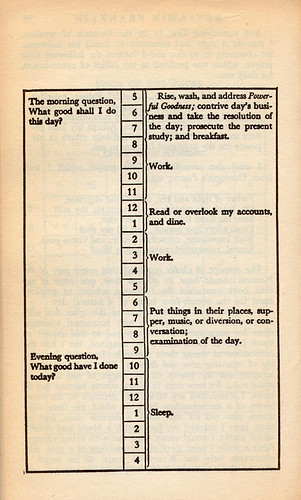
Perhaps the internet really is wise through sheer volume of activity. I loved coming across this scan:

That’s quite a schedule old Ben kept. My first thought was “yeah, that’s a bachelor.”

The Road to Digital Considered

A recent posting on Ars Technica about the American Chemical Society’s “road to digital” publishing spurred an interesting discussion, but a surprising number of posters fumed about the loss of print. I took a moment to write about the issue, using what little I know about how things work for my own society, the American Folklore Society:

I, too, enjoy serendipity and have profited immensely in my intellectual and professional development from reading the card behind the one for which I was searching while in the card catalog or from seeing the title of a book on the shelf above the one for which I was looking. That said, that notion of browsing is not really lost in the digital realm. These things are called “browsers” after all and the rise of the multi-tab interface that allows one to open multiple other texts while one stays focused on another speaks directly to the ability to browse easily in the digital realm.

I am the editor of a website for a small scholarly society in the humanities, the American Folklore Society, that is about to make its premiere on October 1. We are deploying this new/additional communication platform in addition to our journal of record, the Journal of American Folklore. JAF already exists in print and digital form: as a paper product produced and shipped by the University of Illinois Press and as an electronic product available through Project Muse (5 most recent years) and through JSTOR. Having had a chance to talk some with the CIO for JSTOR through the Project Bamboo workshops, I have to say that JSTOR is really trying to do this right. And I would bet that they, too, are looking for some better format than PDF that is, in some ways, too heavily focused on print as an eventual outcome. (You would think in this era of XML and XSLT we would be there already, but, alas, we are not.)

Our society is not alone in being somewhat dependent on the revenue generated by subscriptions to the journal. Like any number of scholarly societies, subscriptions are considerably larger than the active members in the field and are largely dependent upon libraries around the world. In some way, libraries subsidize small scholarly societies as well as, perhaps, large ones. Perhaps that is as it should be. The true cost of running a scholarly society, as opposed to a professional society which can probably charge more for membership, can probably never be born by its members — unless, perhaps, they agglomerate into larger and larger groups for economies of scale. E.g., the American Anthropological Association. (Which now has a number of breakaway groups and journals because the views of the center cannot encompass the many views of its many edges.)

At the same time as all this is happening, libraries have been bearing the costs of both print and digital editions of scholarly products like journals. That kind of expansion of costs for, ostensibly, the same product was bearable when money was less of a concern. But it’s a concern now and likely to remain one for a while. And so, libraries now have to begin making choices that perhaps should have been made a long time ago. Not surprisingly, they find digital more cost effective across a number of fronts.

The obvious needs to be said here: digital production in no way inhibits users from printing out materials and reading them the old-fashioned way. It’s just that the cost of doing so, and the hassle of it to some degree, is now directly born by the print user and not by the larger economy. Pay as you go, as it were. With any luck, some of the hassle will get removed as print-on-demand devices become more common and more available so one could download an entire copy of a journal and have it printed and bound — that’s one of the satisfactions of hoisting a book that I don’t know the digital realm will ever replace.

I should be clear: I love books. I love the way they feel, smell, look. I paid my way through undergrad and parts of grad doing graphic design work. I love the printed page. But I’m also a realist, and we’re in serious need of a re-think about how all this goes. I know some will lament the loss of page numbers for citations, but what need the page number when you can search the text for the quotation yourself and get to it faster than flipping through pages and scanning paragraphs?

Page 2 of 24

© John Laudun